
Project management for 3D studios
One ticket per image, one page per client job.
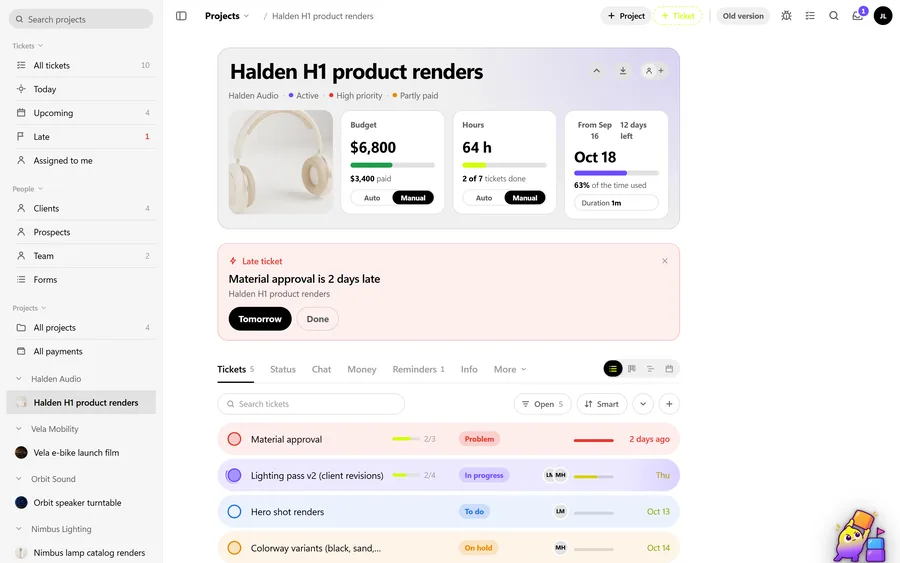
Product renders, packshots, exploded views, turntables, a few animated loops for the launch. The job is a list of deliverables, each with its own feedback and its own deadline, and half of them are modelled by a freelancer. OIO gives the job one project page and each deliverable one ticket, with the quote and the invoice on the same project.
No card. Set up takes ten minutes.
Where the job goes wrong
A typical product job starts with CAD files that arrive late and in the wrong format, a brand guide, and a reference board the client made in a hurry. Then it splits: eight stills, a 360 turntable, two lifestyle scenes with a freelancer doing the set.
Feedback comes back per image, in an email with a PDF of screenshots, or in a call. By the third round nobody is sure which notes were done, which colourway the client approved, or whether the freelancer saw the latest list. The render deadline does not move.
How a 3D job runs in OIO
- 1
Brief and source files
The client sends CAD or STEP files, product photos, the brand guide and references. Something is always missing.
In OIO: The project page holds the brief, the files and the deadline. References go on the project whiteboard, so the moodboard and the brief sit next to each other.
- 2
Break the job into deliverables
Hero packshot, three angles on white, an exploded view, a turntable, two lifestyle scenes. Each has its own resolution, its own aspect ratio and often its own deadline.
In OIO: One ticket per image or shot, with a start and end date. The kanban shows what is in progress, blocked or done; the timeline shows the deliverables against the launch date.
- 3
Modelling and lookdev with freelancers
A freelancer builds the environment or the product model while the studio does lighting and materials.
In OIO: Send the freelancer the ticket link. They read the brief, download the references, upload clay renders, answer comments and mark the ticket done. No account and no seat.
- 4
Client feedback rounds
Notes come in per image: "make the logo emboss deeper", "warmer key light", "swap to the matte black colourway". Rounds pile up.
In OIO: Put each round's notes on the ticket as checklist items, so the person doing them ticks them off and you can see what is left. Set the ticket to hold while you wait on the client.
- 5
Finals and delivery
Full-resolution stills, layered files on request, the turntable as video.
In OIO: Send the finals with a download link that expires after 1, 7 or 30 days, up to 1 GB for a video file. The client's status link shows which deliverables are done.
- 6
Quote, freelancer cost, invoice
The quote was per image. The freelancer invoices you in their own currency.
In OIO: The quote and the invoice come from the project, with lines like 8 x packshot at a price per image. Record the freelancer's fee on the same project in their currency, at that day's rate.
Quoting per image
Most product work is quoted per image with a set number of feedback rounds, plus the modelling as its own line when the client has no usable CAD. In OIO each of those is a line on the quote with a quantity, a unit and a price, so 8 images at one price and a turntable at another read the way the client thinks about them.
When a client asks for a fourth round on an image quoted with two, add it as a line on the next invoice. The checklist on the ticket shows what was asked in each round, which makes that conversation shorter.
What OIO does not do
Better to know before you move a live job over.
- There is no markup tool. Clients cannot draw on a render in OIO; their notes arrive as text and you put them on the ticket.
- There is no version stack. Files on a ticket are a flat list, so name them by round (packshot_r2.png) if you keep the history there.
- There are no plug-ins for Blender, 3ds Max, Maya or Cinema 4D, and no render farm connection.
- There is no time tracker. Hours on a ticket are a number you enter.
What it costs
Free for 3 projects and 3 clients, no card. Solo $12 a month, Pro $29, Studio $69 a month for 5 seats. People who only view, and freelancers on a ticket link, use no seat.
Start with one free projectNo card. Set up takes ten minutes.
Questions
Can my client mark up renders in OIO?
No. OIO has no drawing or pinned comments on images. Most clients send notes by email or on a call; you put them on the ticket as checklist items, which is what the person doing the work needs anyway. If drawn notes on the frame are essential, a review tool does that and OIO does not.
How do I keep track of revision rounds?
OIO has no round counter. Start each round's notes on the ticket with the round number, for example "R2: deeper logo emboss", and tick them off as they are done. The ticket then holds the full history of what was asked and when.
Do my freelancers need a seat or an account?
No. You send a freelancer a link to one ticket. In a browser they read the brief and the checklist, download the files, upload their work, comment and set the ticket to done. Only people who edit inside the studio account take a seat.
Can I quote per image in any currency?
Yes. Quote lines take a quantity, a unit and a price, and the quote and the invoice can be in any currency. The freelancer's cost goes on the same project in their currency, stamped with that day's rate.
Does it work for animation as well as stills?
For the project side, yes: one ticket per shot or per deliverable, dates on the timeline, files and comments on the ticket. There is no video review player, so frame-accurate notes are written with a timecode.
Further reading
- Best project management software for 3D studios (2026)
- Managing freelancers in a small 3D studio
- ShotGrid alternatives for small studios
- OIO vs ShotGrid
- A ClickUp alternative for creative studios
- Project management for archviz studios
- Project management for motion design studios
- OIO for studios that work with freelancers